5.5 Festival Field Report
A field report from the 2023 5.5 Festival Zone 6 operation, covering B6CRA operations, balcony FT8 contacts, and thoughts on bringing more newcomers into amateur radio.
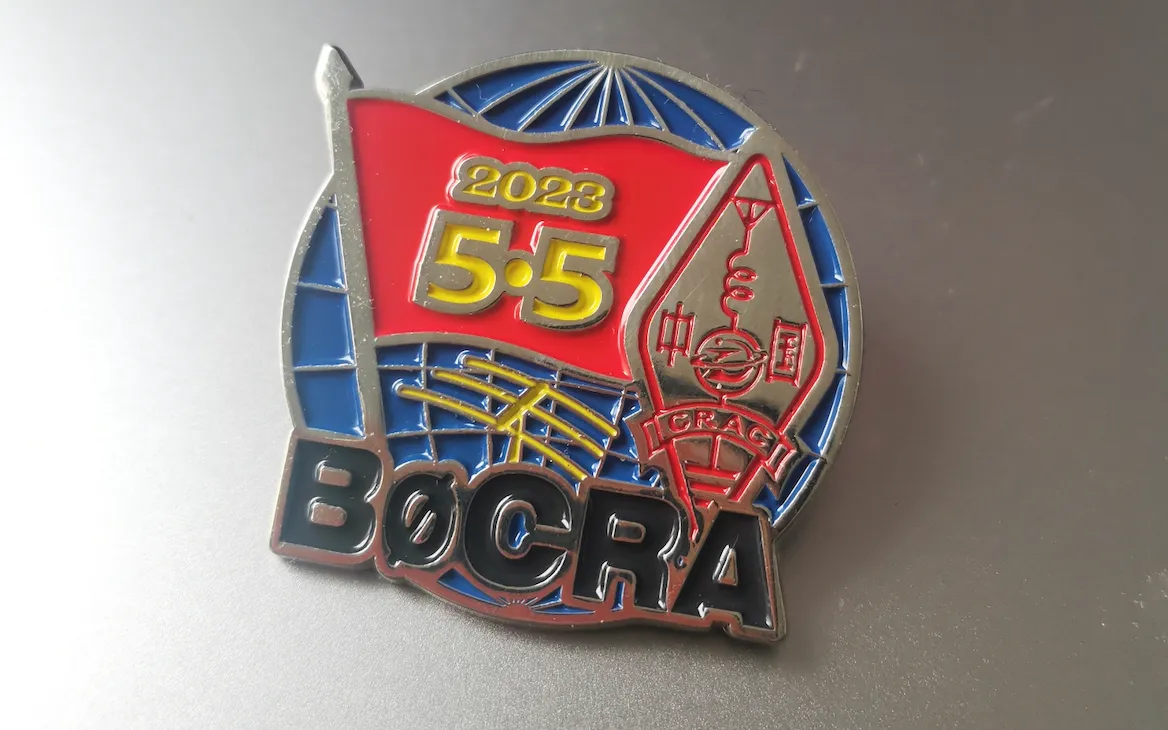
A short write-up, mostly as a record.
This year, I was honored to serve as one of the duty control operators for Zone 6 during the 2023 5.5 Festival. Through this event, I met many experienced operators, learned a great deal, and also became more aware of my own shortcomings and mistakes. Here is my summary.
As one of the control operators for B6CRA, I made roughly 200 QSOs during this year’s 5.5 Festival. Most of them were on the higher bands, mainly 17m, 15m, and 10m. SSB accounted for about 45%, CW for only around 5%, and the rest were FT8. Most FT8 contacts were with European stations, while SSB was mainly domestic. My operating shift still feels a little regrettable, because the festival happened to fall during a few very busy days for me. In practice, I was only able to operate on the 1st and 2nd.
I operated from two locations: Boquan and my own residence.
Boquan has an excellent location, a clean surrounding environment, and a good RF environment. I went there in advance on April 29 to check the site and equipment, and I also did some basic cleanup. On May 1, I went to Boquan with several senior operators, bringing equipment and tools for the operation. Challenges arrived one after another. After the usual cleanup and cabling, we found problems with both the equipment and the antenna system: the Yagi rotator controller had been damaged by induced lightning, the tuner stopped working after some transmitting, and the computer controlling the Flex-6300 kept crashing because of driver conflicts.
Everyone worked hard to solve the problems. Unfortunately, only the computer fully recovered after reinstalling the system. The rotator and tuner remained unusable. After checking the antenna direction, we found that the Yagi was fixed roughly 60 degrees east of north, which was barely usable. Without the tuner, 20m temporarily had the best SWR, so we used that band with a 2kW amplifier for fixed-direction operation.
I was responsible for transmitting during a short period in the morning and again in the evening. The combination of 500W output and the Yagi performed very well, and pile-ups continued under my operation. It was powerful. The other operators were also busy: BG6TOE used BG6QBY’s remote Flex-6400 for CW, while BG6WBU operated FT8 remotely. That afternoon, I learned BA6QR’s standard English calling style and his skillful way of handling pile-ups. I also got to see my mentor, unusually, operate SSB. BG6QBY’s professional knowledge and practical experience also left a deep impression on me.
Overall, despite the regret of equipment being damaged by circumstances outside our control, the Boquan operation performed very well.
After a full day of work, I had other commitments the next day, so I only extended a vertical dipole from my balcony and operated FT8. My residence is in the urban area, inside a residential neighborhood, and the noise floor was almost visible to the naked eye. Downstairs, rows of charging electric bikes seemed to be staring expectantly at my antenna. In that RF environment, CW and SSB were basically out of the question.
I took out my 20m element and slowly adjusted it to resonate on 17m. Once I connected it to the antenna analyzer, the SWR curve looked like an end-fed antenna, which was very strange. I opened the feed box and, unsurprisingly, one element had disconnected from the feedline. I had no soldering iron or solder on hand, so I had to temporarily persuade the two parts back together with a lighter. After reconnecting everything, the antenna and radio finally worked successfully on 17m.
To my surprise, FT8 on 17m also produced a pile-up. On average, every cycle brought 4 or 5 stations replying to my call, and I was not even transmitting at full power. FT8 really does lower the difficulty of making contacts. After several hours of operating and roughly 100 QSOs, it was already late at night. I retracted the antenna, turned off the lights, shut down the radio, uploaded the log, and prepared to go QRT.
I was lying in bed when heavy rain woke me up in the early morning. Half asleep, I checked the headquarters station status on my phone and found that every Zone 6 FT8 station was online, from 160m all the way up to 6m. It was 2 a.m. I could only respect that level of dedication. For me, though, with wind and rain that strong, my antenna would have been impossible to control once extended. So I could only feel grateful to the operators who were still online, turn over, and go back to sleep.
That was the end of my operating shift. On the third day, I returned to a busy work schedule and could no longer participate. I am very grateful to all the senior operators for giving me the opportunity to take part.
This year, Zone 6 had the largest number of participating operators, and we made about 7,000 QSOs. I regret not being able to contribute more contacts, but the active participation of newer operators in Zone 6 gave me hope. During the event, many young operators actively listened to special event stations from different zones, recorded the signals carefully, and discussed them enthusiastically.
Personally, I think the 5.5 Festival is already successful if it helps more people learn about amateur radio and take part in the hobby. In future events, perhaps we could add SWL certificates to encourage listeners who do not yet have transmitting conditions. Giving more people a sense of participation and achievement might make the event even better.